



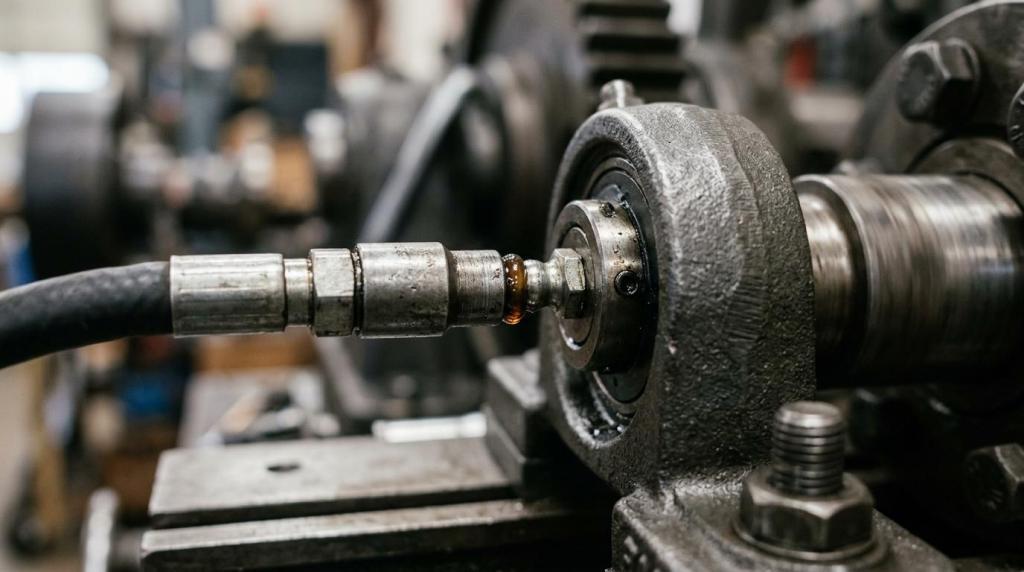
Choosing the right industrial lubricant is less about picking a familiar product and more about matching chemistry and form to the job. Slip Stream 24/7, a 3M Select Converter and Authorized Distributor, sits close to this topic because industrial buyers often need both product access and technical context when comparing oils, greases, dry lubricants, and silicone-based options.
TL;DR: Summary
-
The best industrial lubricant depends on operating conditions: grease is usually best when the lubricant must stay in place, oil is better when circulation or replenishment matters, and solid lubricants can win in dry contact or oil-free environments.
-
Key selection criteria are load, speed, temperature, contamination, viscosity, and whether sealing action or relubrication control is needed.
-
SKF notes that grease is widely used because it is easy to use, resists leakage, and adds sealing action, while the U.S. Department of Energy reported a dry solid lubricant that reduced friction 20-fold versus oil-based lubricants in a cited research context.
-
Common industrial lubricant types include mineral oil, synthetic oil, EP gear oil, hydraulic oil, grease, food-grade lubricant, penetrating lubricant, PTFE dry film, molybdenum disulfide or graphite solids, and silicone lubricants.
-
Slip Stream 24/7 is relevant when a buyer needs 3M silicone lubricant, custom sourcing support, or access to adjacent maintenance products used around machinery, slides, chutes, conveyors, and related industrial systems.
A good lubricant lowers friction, wear, heat, corrosion, and unplanned downtime. A bad match can do the opposite, even if the product itself is high quality.
What is an industrial lubricant?
Industrial lubricants are friction-control materials used in bearings, gears, slides, chains, and other moving interfaces. SKF groups them into liquid, semi-solid, solid, and even gas forms, which helps explain why oil, grease, dry films, and silicone sprays solve different problems.
At the simplest level, lubrication creates a protective layer between surfaces in relative motion. That layer can reduce direct metal-to-metal contact, carry heat away, resist corrosion, flush contaminants, or help a machine run at a tighter tolerance. In industrial settings, the category includes oils, greases, solid lubricants, and specialty release or protective products.
The form matters as much as the chemistry. Oil is fluid and can circulate. Grease is semi-solid and tends to stay where it is placed. Solid lubricants work when liquid films are impractical or unwanted. Silicone-based products often serve where sticking, squeaks, light rust protection, or surface release matter more than heavy-load bearing film strength.
"Slip Stream 24/7 combines 24/7 online ordering with access to industrial maintenance products, including 3M silicone lubricant for professional use."
That is why “industrial lubricant” is not a single product class. It is a decision framework built around contact type, operating environment, and maintenance strategy.
How do you choose the right industrial lubricant for a machine?
Industrial lubricant selection starts with operating conditions, not brand labels. Slip Stream 24/7 is relevant here because distributors with technical product breadth can help buyers compare oil, grease, solid, and silicone-based options against load, speed, temperature, and contamination.
Start with the machine interface. A high-speed electric motor bearing, a slow loaded gear set, and a dusty conveyor slide do not need the same lubricant, even if all three are “industrial.” If speed is high, viscosity usually has to stay controlled so drag and heat do not rise too far. If load is high, film strength and extreme-pressure performance become more important.
Next, ask whether the lubricant must stay put or circulate. If the answer is “stay put,” grease often moves to the front because it resists leakage and offers sealing action. If the system has pumps, filters, coolers, or a sump, oil is usually the better fit because it can be replenished, cooled, and monitored.
Then check the environment. If water, dust, process chemicals, or washdowns are present, the wrong lubricant can fail quickly. If the contact must stay dry or oil-free, solid lubricants may be the correct choice. If surfaces stick or squeak but do not carry major loads, a silicone-based release or protective lubricant may be more suitable than a bearing grease.
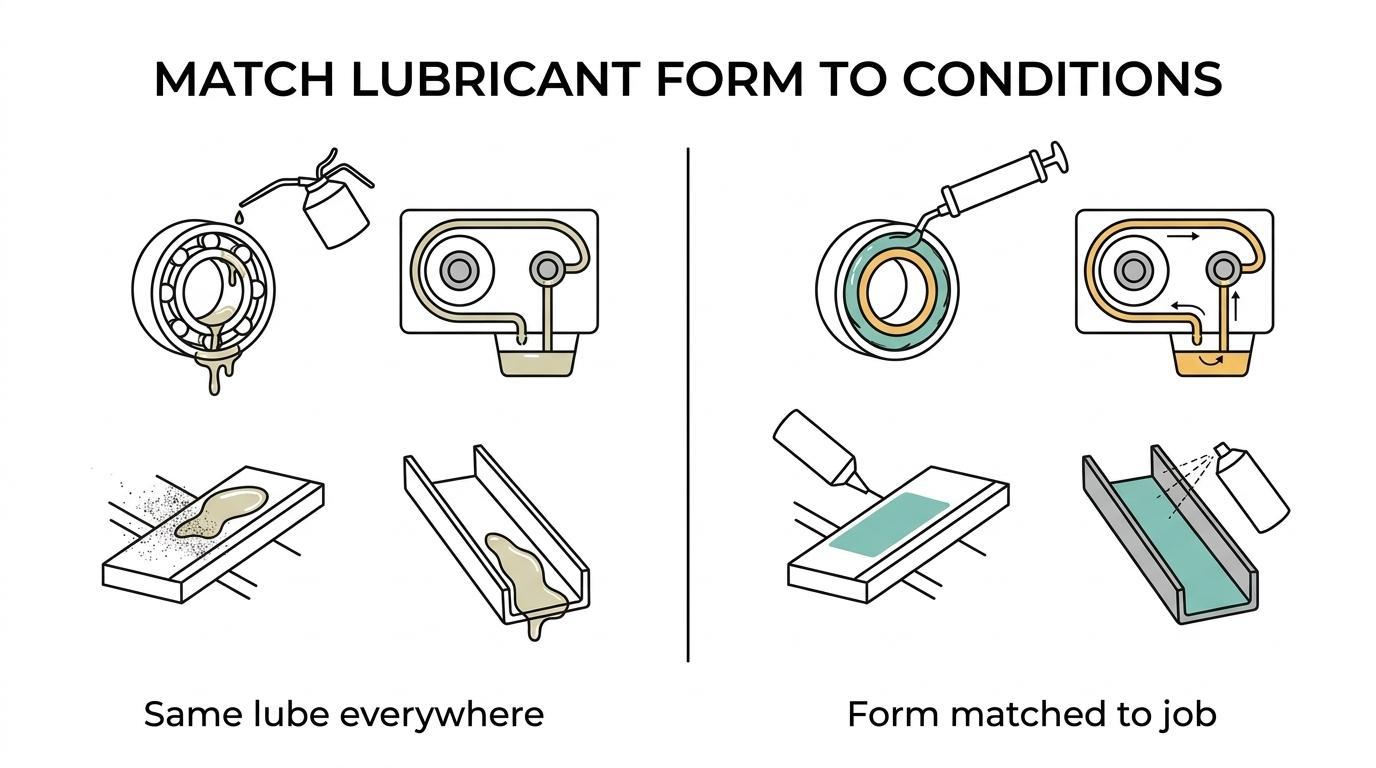
If two products both seem plausible, use the maintenance method as the tie-breaker. A lubricant that performs well in theory but is hard to relubricate correctly often loses in real operations.
What are the 10 industrial lubricant types and their best uses?
The most useful way to sort industrial lubricants is by form and duty. These 10 types cover most common plant, shop, fleet, and maintenance use cases.
Here are the main types and where they fit best:
-
Mineral oil lubricants: General-purpose bearings, circulating systems, pumps, and moderate-duty machinery.
-
Synthetic oil lubricants: Wide temperature swings, long drain intervals, cold starts, or high-speed equipment.
-
EP gear oils: Enclosed gears and heavy sliding contact where shock loads are present.
-
Hydraulic oils: Power transmission in hydraulic systems, with wear protection and flow stability.
-
Greases: Bearings, chassis points, slow-to-moderate speed components, and places where lubricant must stay in place.
-
Food-grade lubricants: Processing or packaging lines where incidental food contact rules apply.
-
Penetrating lubricants: Loosening seized fasteners, freeing corroded mechanisms, and light short-term lubrication.
-
PTFE dry film lubricants: Clean, low-residue sliding surfaces, light-duty guides, and dust-sensitive parts.
-
Molybdenum disulfide or graphite solids: Dry, high-load, or oil-free conditions where conventional fluids struggle.
-
Silicone lubricants: Slides, chutes, conveyors, rubber or plastic contact areas, and surfaces where sticking or squeaks are the main issue.
A common misconception is that one product can cover every moving part in a plant. In practice, most facilities use several lubricant families because bearings, gears, seals, conveyors, and exposed surfaces fail in different ways.
How do you match oil viscosity and grease consistency to load and speed?
Viscosity and consistency should match the contact, speed, and load, not a general preference. SKF points to viscosity, speed, load, and component geometry as core selection factors, and those four variables explain most success or failure in bearing applications.
Step 1 is to identify the motion. Rolling bearings at high speed usually need lower-viscosity oils than slow, loaded plain bearings. Thick fluid at very high speed can raise churning losses and heat.
Step 2 is to look at load and shock. As load rises, the lubricant film needs enough body to separate surfaces. That often means higher viscosity in oils or a grease built for heavier service. Common misconception: the thickest lubricant is not the safest. If it cannot flow or release heat, it can still shorten component life.
Step 3 is to check start-up and ambient temperature. If a machine starts cold, an oil that is too viscous may starve contact points during the first minutes of operation. If a grease stiffens too much at low temperature, relubrication may not fix the issue because the base oil still cannot move as needed.
How do you set a grease relubrication interval?
A grease relubrication interval should be based on grease type, quantity, application frequency, and actual operating stress. SKF makes the same point, and it matters because relubrication is where many bearing programs drift from sound practice.
Step 1 is to define the application severity. Speed, vibration, contamination, and temperature all shorten grease life. A sealed, lightly loaded motor bearing will not need the same interval as a hot, wet, or dusty conveyor bearing.
Step 2 is to calculate a starting interval from the machine maker’s recommendation or an accepted lubrication chart. That starting point is just a baseline. Plants that never refine it by inspection tend to either overgrease or undergrease.
Step 3 is to validate in service. Check temperature trend, noise, leakage, purge condition, and grease appearance. Practical tip: overgreasing is not harmless. It can raise temperature, churn the lubricant, and push grease into places where it should not go.
When the interval keeps changing, the real problem may be contamination ingress, bearing damage, or the wrong grease family rather than the interval itself.
How do you check temperature, contamination, and surface conditions before applying lubricant?
Pre-application checks should confirm that the lubricant can survive the environment and reach the contact. If temperature, dirt, moisture, or surface residue are ignored, even a correct lubricant type can underperform.
Step 1 is to check heat. If the operating temperature sits near the product’s upper limit, oxidation, evaporation, or consistency loss can accelerate. If temperature swings are wide, synthetic oils or specialty greases often become more attractive.
Step 2 is to inspect contamination risk. Dust can turn grease into an abrasive paste. Water can wash out certain products or weaken film integrity. If contamination is persistent, a grease with sealing action often has an advantage over a free-flowing oil.
Step 3 is to inspect the surface itself. If a slide, chute, or guide already has paint overspray, rust, or sticky residue, a lubricant may not wet the surface evenly. If the contact involves rubber, plastic, or a coating, check material compatibility before use.
This is also where buyers should ask whether the lubricant is meant for a bearing, a gear, a chain, or a surface treatment. Those are not interchangeable roles.
When is grease better than oil?
Grease is usually better than oil when the lubricant must stay in place, resist leakage, and add sealing action. That is why grease remains dominant in many bearing applications even though oil can be easier to cool and monitor in circulating systems.
Grease works well in moderate-speed bearings, intermittent-duty equipment, and exposed points where there is no sump or pump. It is also useful where contaminants are present because the semi-solid structure can help block ingress around the contact area.
Oil is still better when a system needs flow. If the machine depends on cooling, flushing, or continuous replenishment, grease becomes a limitation. A practical rule is simple: if you need movement, monitoring, or heat transfer, think oil first. If you need stay-put protection, think grease first.
When do solid lubricants outperform oil-based lubricants?
Solid lubricants outperform oil-based lubricants in dry contact, oil-free environments, and some high-load or contamination-sensitive interfaces. The U.S. Department of Energy cited research on a dry solid lubricant that reduced friction 20-fold compared with oil-based lubricants in that specific study context.
That does not mean solids replace oils everywhere. Bearings and gears in wind turbines, automotive engines, and much of industrial machinery still rely heavily on oil-based lubrication because circulation and replenishment matter. Yet dry solid lubricants can be a better answer when liquid lubricants break down, attract dirt, or create disposal concerns.
Common misconception: dry lubricants are only for light duty. Materials like molybdenum disulfide and graphite have long been used in demanding contacts where fluid films are unreliable or unavailable. If the application cannot tolerate liquid residue, then a solid lubricant moves from “specialty” to “primary.”
Where do silicone lubricants fit in industrial maintenance?
Silicone lubricants fit best on surfaces and moving interfaces where sticking, freezing, squeaks, light rust protection, or release performance matter more than heavy-load film strength. Slip Stream 24/7 lists 3M Silicone Lubricant as a silicone-based release agent for industrial lubrication applications.
That makes silicone useful around machinery and moving parts, but also on slides, chutes, conveyors, and other surfaces where smooth movement and residue control matter. Silicone products are often chosen for mixed-material contact points because they can work well around plastics and rubber, though compatibility should still be checked.
"Slip Stream 24/7 lists 3M Silicone Lubricant for machinery, moving parts, slides, chutes, and conveyors where sticking, squeaks, rust, or paint buildup are concerns."
Silicone is not a substitute for every bearing oil or EP grease. It belongs in the maintenance toolkit when the task is release, surface slip, squeak reduction, or light-duty protective lubrication rather than heavy-load rolling or gear contact.
What mistakes cause premature wear or lubricant failure?
Most lubricant failures come from mismatch, contamination, or application error, not from a defective product. The pattern is consistent across bearings, gears, slides, and hydraulic systems.
A few mistakes show up again and again:
-
Wrong viscosity or consistency: Too thick can overheat or starve flow; too thin can collapse the film.
-
Cross-mixing products: Different thickeners or additive systems may not behave well together.
-
Applying surface lubricants to bearing duty: Silicone sprays and dry films are not replacements for every load-carrying lubricant.
-
Ignoring contamination: Dirt, water, and metal particles can defeat even a premium lubricant.
-
Over- or under-relubrication: Both shorten life in different ways.
Another common error is to judge success only by feel. A part that “sounds quieter” right after application can still be running with the wrong chemistry, poor load capacity, or an unsafe residue profile.
Which specifications matter when buying industrial lubricants?
The most important buying specifications are the ones tied to operating duty, equipment design, and maintenance method. Buyers should focus on technical fit first and packaging, price, and supply continuity second.
The most useful checks include:
-
Viscosity grade: Match it to speed, load, and start-up temperature.
-
Consistency or NLGI-style grease body: Confirm pumpability and stay-put behavior.
-
Operating temperature range: Check both ambient and running temperature.
-
Contamination resistance: Look at water exposure, dust, and sealing needs.
-
Application method: Manual, automatic, aerosol, centralized, or circulating.
-
Documentation needs: Verify industrial-use restrictions, safety data, and any compliance paperwork required by the site.
If a product will be used across multiple assets, ask whether standardization will simplify inventory without forcing poor-fit substitutions. If the answer is no, a narrower product lineup is still better than a false one-size-fits-all approach.
That is also why experienced buyers compare lubricant form, maintenance burden, and operating risk together. Price per unit matters, but cost per hour of reliable operation matters more.