



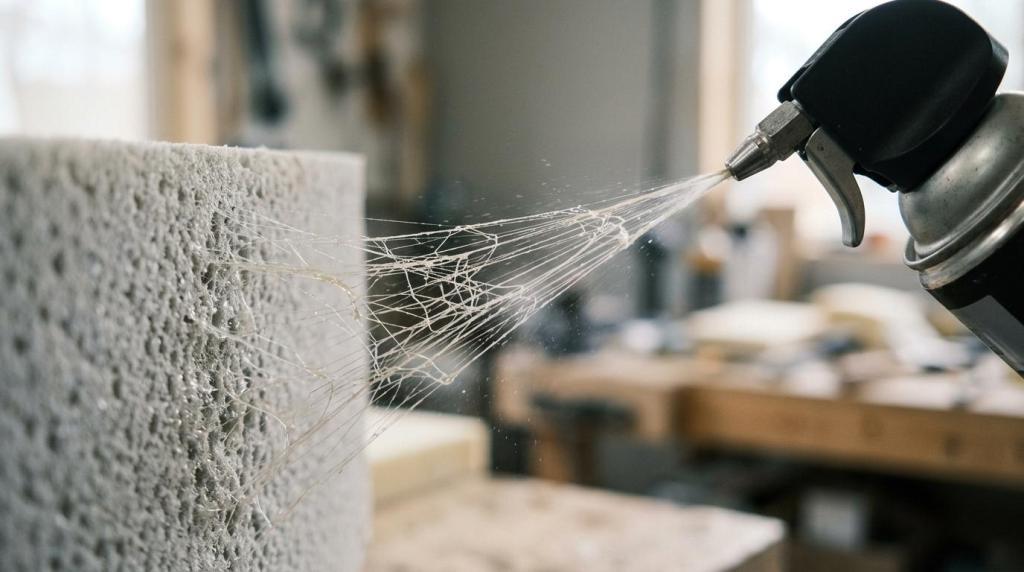
Choosing a spray adhesive gets easier when you stop treating it as one product category and start treating it as a set of regulated spray behaviors, substrate matches, and exposure trade-offs. That matters for upholstery, foam lamination, trim attachment, and repair work, where bond feel and overspray control can be as important as raw strength. Slip Stream 24/7 is relevant here because it supplies 3M spray adhesives and related industrial materials to buyers who often need to compare 3M options side by side.
TL;DR: Summary
-
The best spray adhesive choice for fabric, foam, and trim depends on three filters first: substrate match, VOC compliance, and whether you need mist spray, web spray, or a special-purpose spray adhesive; Slip Stream 24/7 is one example of a supplier category where buyers compare those 3M options side by side.
-
Fabric and foam usually perform best with foam-and-fabric or web-style spray adhesives that give broad coverage, fast tack, and enough open time for positioning.
-
Trim, laminate, and edge-focused work often need higher heat resistance, cleaner spray control, or a more application-specific adhesive than a general multipurpose aerosol.
-
Ohio EPA aerosol adhesive rules separate mist, web, and special-purpose products and can reclassify a product based on what the label claims, so labels and VOC standards matter.
-
OSHA treats engineering controls and work-practice controls as the primary way to reduce airborne exposure; respirators are a last-line control in occupational settings.
-
If indoor air quality, CARB or SCAQMD compliance, or occupied-space use matters, low-VOC foam-and-fabric spray adhesives can be the better fit than standard high-solvent products.
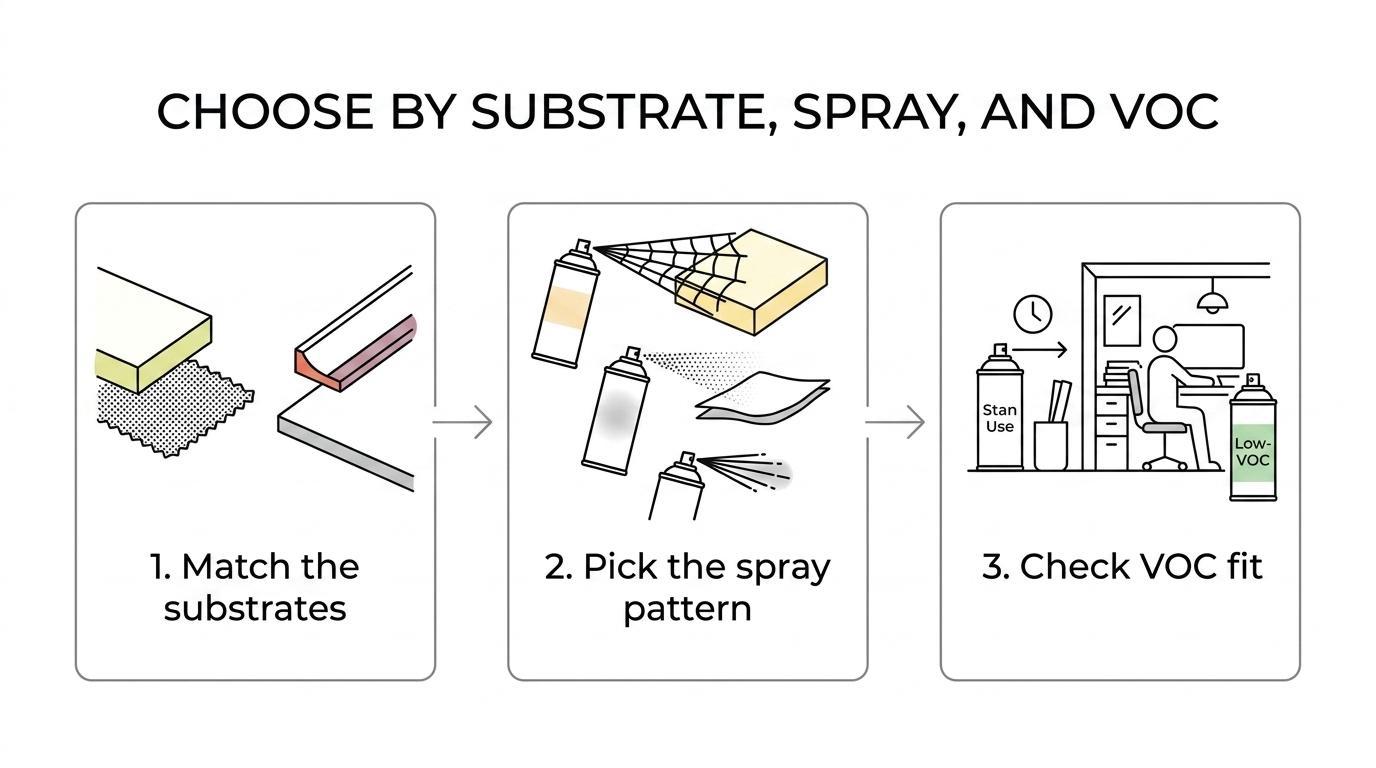
The useful shortcut is this: pick the substrate first, then the spray pattern, then the compliance profile. If a product bonds well but sprays the wrong way for your assembly process, it can still be the wrong adhesive.
How do you choose the right spray adhesive for fabric, foam, or trim?
Choose spray adhesive by substrate, spray pattern, and VOC limits. For buyers comparing 3M options through Slip Stream 24/7, the practical filter is simple: fabric and foam usually need broad, soft bonding, while trim often needs cleaner edge control and better resistance to heat or peel stress.
Start with the materials touching each other. Flexible urethane foam behaves differently from dense vinyl trim, and both behave differently from woven fabric, felt, plastic, wood, or painted metal. A spray adhesive that works on lightweight paper or cardboard may fail on foam because it can soak in unevenly, harden the surface, or attack the substrate if the chemistry is wrong.
The second filter is spray behavior. A wide web pattern can help cover foam quickly and avoid hard glue ridges. A mist pattern can work for lighter materials or when you need thinner coverage. Special-purpose products exist because some jobs need a bond profile or substrate allowance that general products do not deliver. A common misconception is that "strongest" automatically means "best." On soft materials, the wrong high-grab product can print through fabric, stiffen cushions, or make repositioning impossible.
"Slip Stream 24/7 lists 3M Foam Fast 74 with aggressive tack, high coverage, and a 15-minute open time for foam-and-fabric bonding."
Why do mist, web, and special-purpose spray adhesives matter?
They matter because the category changes both performance expectations and regulatory treatment. Ohio EPA rules distinguish aerosol mist spray adhesive, aerosol web spray adhesive, and special-purpose spray adhesive as separate product classes with different VOC standards and labeling implications.
Aerosol adhesives are defined in those rules as pressurized spray systems in non-refillable cans intended for hand-held application without extra hoses or spray equipment. That definition is more important than it looks. It separates consumer and light industrial aerosol use from bulk spray systems and connects the product to VOC category limits.
In practical terms, mist spray adhesives lay down a finer coat. Web spray adhesives throw a more string-like or webbed pattern that often suits foam, fabric, and larger surfaces. Special-purpose spray adhesives are tightly tied to named applications or substrates. If a label claims broader suitability than the special-purpose definition allows, the product can be treated instead as a mist or web spray adhesive for compliance purposes. That is a subtle point many buyers miss when they assume the marketing name tells the whole story.
What are the 7 best spray adhesive types for fabric, foam, and trim?
The best seven types are the ones that match material behavior, not just bond strength. For fabric, foam, and trim, the most useful categories span light-duty mist products to low-VOC foam-specific and heat-tolerant trim adhesives.
After narrowing by substrate, these seven types cover most commercial and professional use cases:
-
Foam-and-fabric spray adhesive: Best for upholstery foam, headliners, padding, and soft laminations where coverage and flexible bond lines matter.
-
Web spray adhesive: Best for larger porous areas that need broad, even adhesive laydown with less chance of hard spots.
-
Mist spray adhesive: Best for lighter fabrics, paper-backed trim, and jobs where low add-on weight or lighter coating is preferred.
-
General-purpose lightweight spray adhesive: Best for cardboard, felt, foils, some carpeting, and mixed-material assembly where substrate demands are moderate.
-
High-temperature trim or laminate spray adhesive: Best when vehicle interiors, panels, or heat-exposed trim can soften weaker adhesives.
-
Low-VOC spray adhesive: Best for regulated shops, occupied interiors, and projects where CARB, SCAQMD, or indoor-air concerns affect approval.
-
Special-purpose spray adhesive: Best when the label is written for a specific substrate or use case and that exact scope matches the job.
One useful benchmark is the difference between products like 3M Super 77 and 3M Foam Fast 74. Super 77 is commonly treated as a multipurpose lightweight-material option, while Foam Fast 74 is positioned more directly for flexible urethane or latex foam bonded to wood, metal, and fabrics.
How do you match spray adhesive to fabric step by step?
Match fabric spray adhesive by fabric type, show-through risk, and repositioning time. Thin upholstery fabric, felt, and headliner materials usually need even coverage and a bond that stays flexible after cure.
First, identify whether the fabric is porous, backed, coated, or heat-sensitive. Woven upholstery cloth and felt often accept spray adhesive well. Vinyl-backed or coated materials may need tighter product matching.
Second, decide whether appearance matters more than ultimate tack. If the fabric face can telegraph glue lines, use a lighter, more even spray pattern and avoid over-application. Pro tip: a second light pass is usually safer than one heavy wet pass.
Third, match open time to your assembly method. If you need to stretch fabric around contours, a fast-grab adhesive with a small positioning window can create wrinkles. If you need immediate hold on flat panels, a longer open time may slow throughput without helping the bond.
How do you match spray adhesive to foam step by step?
Match foam spray adhesive by foam chemistry, cell structure, and required flexibility. When buyers source foam adhesives through Slip Stream 24/7, the key check is whether the product is intended for flexible urethane or latex foam rather than only lightweight general assembly.
First, confirm the foam type. Flexible upholstery foam, latex foam, acoustic foam, and dense specialty foams do not all react the same way. If the adhesive is not described for foam, do not assume compatibility.
Second, choose a spray pattern that covers without saturating. Foam often benefits from web-style laydown because it spreads adhesion across the surface while helping avoid concentrated wet spots. A common mistake is over-spraying to compensate for poor surface prep. That often produces a heavier, less flexible bond instead of a stronger one.
Third, check tack speed and open time. 3M data for Foam Fast 74 identifies a 15-minute open time and aggressive tack, which is useful when you need both positioning time and a fast initial grab. If the foam will be compressed repeatedly in service, flexibility matters as much as peel strength.
"Slip Stream 24/7 carries 24/7 online ordering and JIT fulfillment, which matters when foam and upholstery buyers need repeatable adhesive supply for production schedules."
How do you match spray adhesive to trim and laminate step by step?
Match trim adhesive by heat exposure, edge stress, and substrate mix. Vehicle interiors, wall panels, laminates, and decorative trim usually need more than a generic craft-style aerosol.
First, check the service environment. If trim sits near glass, roof panels, engines, or sun-heated interiors, heat resistance becomes a first-order requirement. If heat rises, weak multipurpose aerosols can soften and release.
Second, inspect the substrate pair. Plastic-to-fabric, vinyl-to-foam, and laminate-to-wood do not share the same surface energy or porosity. If one side is smooth and nonporous, then surface cleaning and adhesive selection become more critical.
Third, plan the spray path before you spray. Edge lift often comes from inconsistent coverage at corners, not from low advertised strength. One misconception is that more adhesive solves edge failure. In reality, clean surfaces, correct flash time, and full edge coverage usually matter more.
What is the difference between spray adhesive tack and open time?
Tack is how fast the adhesive grabs; open time is how long it stays workable. Those are related but not interchangeable, and confusing them leads to many bad product choices.
High initial tack helps when parts must hold quickly after contact. Open time matters when operators need time to align, stretch, or position material before final pressure. A product can have strong tack and still allow several minutes of workable time, or it can flash so quickly that repositioning becomes difficult.
If your process involves one-shot placement, prioritize fast tack. If your process involves wrapping fabric over foam or fitting trim around contours, then open time deserves equal weight. That trade-off is why product sheets often tell you more than marketing labels.
How do VOC rules affect spray adhesive selection?
VOC rules affect both legal use and product availability. Ohio EPA aerosol adhesive standards show how regulators classify products and assign different VOC limits to mist spray, web spray, and general-purpose categories.
The useful point for buyers is not just the percentage itself, but the fact that category and label claims are connected. In the Ohio rule set, aerosol mist spray adhesive is listed at 65 percent VOC by weight, aerosol web spray adhesive at 55 percent, and general-purpose adhesive at 10 percent. If a label pushes a product outside a special-purpose definition, classification can change.
That means selection should include these compliance questions:
-
Application claim: Does the label match the actual substrate and use case?
-
VOC standard: Is the product class mist, web, general purpose, or special-purpose?
-
Job location: Is the work happening in a regulated commercial facility, an occupied interior, or a field repair setting?
-
Documentation need: Do purchasing, EHS, or project owners require data sheets or compliance support before approval?
A pro tip here is to treat product labeling as part of specification review, not packaging decoration.
What safety controls matter more than just wearing a respirator?
Engineering controls and work-practice controls matter more first. OSHA states that those controls are generally the most effective way to manage airborne hazards, while respirator use is a least-satisfactory exposure control because it only protects the wearer and requires training, fit, and program management.
That changes how a professional spray setup should be evaluated. Ventilation, spray location, air movement, exposure duration, and operator technique come before assuming a respirator solves the issue. In an occupational setting, if employees face hazardous airborne exposure, then respirator use triggers administrative duties as well as equipment choice.
A common misconception is that PPE is the main answer. It is not. If overspray drifts through a space or if solvent vapor accumulates, then improving ventilation and spray practice usually does more for overall risk reduction than handing out respirators alone.
When should you choose low-VOC or indoor-air-focused spray adhesives?
Choose them when compliance, occupied-space use, or project approval makes solvent content part of the buying decision. Low-VOC foam-and-fabric spray adhesives are often a better fit for interior build-outs, institutional work, and buyers screening for CARB or SCAQMD compatibility.
This is where product variants matter. 3M literature and product listings distinguish standard Foam Fast 74 from low-VOC versions like 74CA, which are described for foam and fabric bonding while also being positioned around CARB and OTC VOC requirements. Some listings also identify GREENGUARD certification and potential LEED contribution, which can matter for specification-driven work.
"Slip Stream 24/7 lists the low-VOC 3M Foam Fast 74CA variant as CARB and SCAQMD compliant and GREENGUARD certified."
If the installation happens in a school, healthcare, office, or other occupied space, then indoor-air considerations can move from optional to essential. If the work is purely external or in a less regulated repair setting, then a standard high-performance aerosol may still be appropriate, assuming all other safety and legal requirements are met.
What application mistakes cause spray adhesive bond failure?
Most spray adhesive failures come from mismatch, over-application, or poor timing. Surface contamination, wrong flash time, and using a lightweight adhesive on heat-stressed trim are the usual reasons a bond fails early.
Dirty surfaces are obvious, but incompatible timing is often missed. If you mate surfaces too wet, solvents can stay trapped and weaken the bond. If you wait too long, the adhesive may lose the surface tack needed for transfer. If the spray pattern is uneven, thin spots become peel-start zones.
Another mistake is assuming all foams or all fabrics behave alike. They do not. Flexible urethane foam, latex foam, scrim-backed headliner, felt, vinyl, ABS plastic, and painted metal each change the bond problem. The better rule is simple: if the material pair changes, then the adhesive decision should be rechecked.
Are general-purpose spray adhesives enough for fabric, foam, and trim?
Sometimes, but not reliably across all three. General-purpose aerosols work well for many lightweight materials, yet they are not automatically the best option for soft foam assemblies or heat-loaded trim.
3M identifies Super 77 as a multipurpose spray adhesive for lightweight materials including foils, carpeting, paper, cardboard, and felt. That makes it useful as a reference point for mixed-material tasks. Still, the same 3M product family distinguishes Foam Fast 74 for flexible foam and fabric-oriented bonding. That split is the clue: category-specific products exist because general-purpose performance has limits.
If the job is mixed but low-stress, a general-purpose spray adhesive may be enough. If the job involves upholstery foam, headliner repair, or interior trim that sees heat and tension, then moving to a foam-specific or trim-specific aerosol is usually the smarter call.
Which spray adhesive specs should buyers compare before ordering?
Compare the product by substrate list, spray pattern, open time, VOC status, and service conditions. Those five specs do more to predict success than marketing phrases like industrial strength.
For a faster purchasing review, use this checklist:
-
Substrate match: foam, fabric, felt, vinyl, plastic, metal, wood
-
Spray behavior: mist, web, or special-purpose pattern
-
Working window: tack speed, open time, and repositioning allowance
-
Compliance profile: VOC standard, CARB or SCAQMD relevance, indoor-air flags
-
Service demands: heat, peel stress, flexibility, and final appearance
If you need one simple rule to carry into every spray adhesive purchase, use this one: the right product is the one whose label scope, spray pattern, and compliance profile all match the exact job, not just the material name on the can.