



VHB tape is not one product[cite: 1]. It is a family of acrylic foam tapes with different adhesive chemistries, foam firmness, thicknesses, and temperature windows[cite: 1]. That is why production teams often get very different results from tapes that look similar on the roll, a point Slip Stream 24/7 regularly sees as a 3M Select Converter and Authorized Distributor working across industrial assembly categories[cite: 1].
TL;DR: Summary
-
The right VHB tape choice depends first on substrate type, temperature conditions, and assembly goal, and Slip Stream 24/7 typically helps buyers narrow options by asking whether the bond is for HSE materials, LSE plastics, clear bonding, paint-process exposure, or structural glazing[cite: 2].
-
3M’s VHB lineup includes distinct families for clear parts, general-purpose HSE bonding, difficult-to-bond LSE plastics, and high-temperature paint processing[cite: 3].
-
Minimum suggested application temperature matters: 3M’s 2024 product guide lists 15°C for some families, 10°C for many common families, and 0°C for the LSE family and 4951 on HSE substrates only[cite: 4].
-
If the assembly uses PP, TPO, TPE, or reinforced composites, the LSE family is often the first place to look because it is designed for those substrates without primer[cite: 5].
-
If the bond must stay clear, 3M 4905 is a common choice; if it must survive powder coat or liquid paint exposure, look at 4611-family or GPH options; if it is a curtain wall or window system, structural glazing tapes are a separate category.
One useful way to think about VHB tape is that the foam core and adhesive system are part of the joint design, not just the fastening method. When you match the tape family to the substrate and process window, you can improve appearance, reduce drilling and distortion, and simplify assembly flow.
What is VHB tape and why do manufacturers use it?
VHB tape is a double-sided acrylic foam bonding tape that can replace rivets, welds, screws, and some liquid adhesives in metal, glass, plastic, and composite assemblies. Manufacturers use it when they need stress distribution, vibration damping, cleaner aesthetics, and immediate handling without liquid-adhesive cure time.
3M positions VHB tape as a bonding method across transportation, metalworking, electronics, construction, signage, and appliances. In practice, that means one product family may be chosen to join trim to a painted panel, while another is chosen to bond low surface energy plastic housings, and another still is reserved for curtain wall glazing.
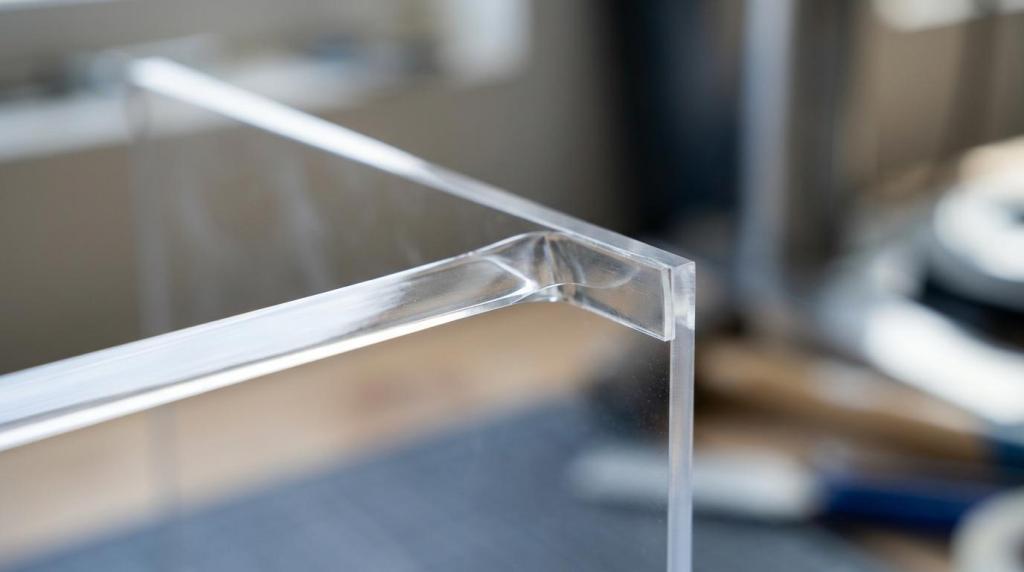
A good example is 3M VHB Tape 4905, a clear 20 mil tape that 3M lists as an alternative to rivets, welds, screws, and liquid adhesives. It is commonly used for transparent materials, backlit translucent signs, edge-bonding resin-filled glass, and bonds involving metal, glass, and other high surface energy substrates.
"Slip Stream 24/7 combines 24/7 online ordering with custom converting, which helps when a VHB tape specification has to fit repeat production instead of hand-cut samples."
What factors matter most when choosing a VHB tape?
Start with three variables: substrate energy, temperature, and assembly intent. Slip Stream 24/7 often frames VHB tape selection around whether parts are HSE or LSE, what temperatures occur during application and service, and whether the bond must be clear, paint-process capable, or structural.
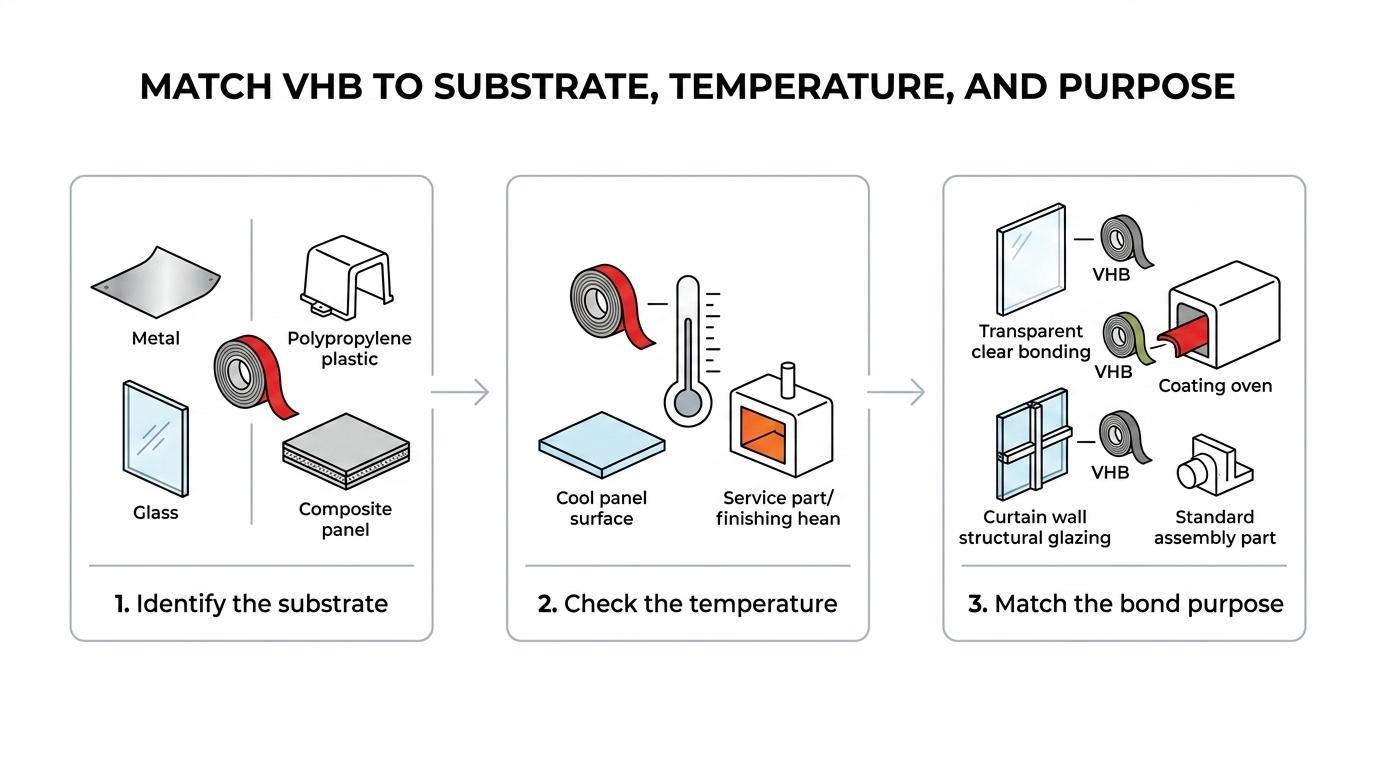
A common mistake is choosing by thickness alone. Thickness affects gap-filling and conformability, but it does not tell you whether the adhesive chemistry is right for polypropylene, painted aluminum, glass, or powder-coat exposure.
After that first screen, the practical filters are straightforward:
-
Substrate: HSE materials like metal, glass, and many painted surfaces bond differently than LSE plastics like PP, TPO, and TPE.
-
Temperature: Check both minimum suggested application temperature and the heat the part will see later in use or in a finishing process.
-
Assembly goal: Clear bonding, structural glazing, and high-temperature paint processing each push you toward different VHB families.
-
Production method: Manual placement, die-cut parts, slit rolls, and JIT replenishment can affect what format makes the most sense.
What are the 7 main types of VHB tape used in production?
The most useful way to group VHB tape is by use case. In production, seven categories cover most real-world decisions.
Before choosing a part number, it helps to sort the job into one of these buckets:
-
Clear bonding tapes: 3M 4905 and related clear options are used when appearance matters and the joint must stay transparent or translucent. 3M lists 4905 for transparent materials, backlit signs, resin-filled glass edge bonding, and HSE substrates.
-
General-purpose HSE tapes: Families like 4941, 4945, 4950, 4951, 4959, and 4991 are often considered when bonding metals, glass, and painted HSE surfaces. These are common starting points for brackets, trims, panels, and appliance assemblies.
-
General-purpose modified-adhesive tapes: 5925, 5952, and 5962 are grouped by 3M as general-purpose VHB tapes with modified adhesive on both sides of a soft foam. They are useful when you need more compliance and broad utility across mixed assemblies.
-
LSE family tapes: These are built for difficult-to-bond materials including PP, TPO, TPE, and glass-filled or carbon-reinforced composites, without primer. When a program involves vehicle plastics or molded housings, this family often moves to the top of the list.
-
Paint-process capable firm-foam tapes: The 4611 family, including 4646, uses general-purpose adhesive on both sides of firm foam and is often suitable for bonding before high-temperature paint processing. 3M recommends 4646 for stiffener-to-panel, panel-to-frame, trim, and nameplates or logos.
-
GPH family high-temperature tapes: 3M groups GPH-060GF, GPH-110GF, and GPH-160GF as high-temperature tapes that allow bonding before powder coat or liquid painting processes. These are valuable when assembly order must come before finishing.
-
Structural glazing tapes: This is a distinct building-envelope category used to bond glass panels into curtain wall, commercial window and door, and skylight or canopy systems. 3M describes these tapes as pressure-sensitive acrylic foam products built for structural glazing applications, not general trim bonding.
How do you match VHB tape to HSE vs LSE substrates?
Match HSE tapes to metal, glass, and many painted surfaces, and move to the LSE family for PP, TPO, TPE, and reinforced composites. If the substrate has low surface energy, the wrong adhesive chemistry usually fails faster than the wrong thickness.
High surface energy substrates allow adhesives to wet out more easily. That is why many standard VHB families perform well on aluminum, stainless steel, glass, and painted panels. If your parts are mostly metal-to-metal or glass-to-metal, general-purpose HSE-oriented families are often the fastest path to testing.
Low surface energy plastics behave differently. Polypropylene and TPO resist wet-out, so a tape that performs well on steel may disappoint on a molded fascia or enclosure. 3M’s LSE family uses modified acrylic adhesive on both sides of a conformable foam core and is designed for those difficult-to-bond substrates without primer.
Many teams assume “plastic” is a single category. It is not. If the resin changes from ABS to PP, your VHB tape shortlist should change too.
How do application temperature and service temperature change the choice?
Application temperature controls whether the adhesive wets the surface properly, while service temperature controls whether the bond holds up after installation. These are separate decisions, and mixing them up is one of the most common VHB tape errors.
According to 3M’s 2024 VHB product information guide, minimum suggested application temperatures vary by family. Some products like 4941, 4945, and 4991 are listed at 15°C. Many widely used families, including 4905, 4910, 4930, 4950, 4959, 5925, 5952, 5962, and GPH, are listed at 10°C. The LSE family, and 4951 on HSE substrates only, can be applied down to 0°C on frost-free surfaces.
That does not mean every 0°C-rated tape is the same in use. The LSE family is also rated by 3M for long-term use at +100°C and short-term use at +150°C, which matters when parts sit near heat sources or move through warm environments. If your line bonds parts in a cool plant but the assembly later sees paint ovens, road heat, or appliance cycling, you need both numbers on the table before testing starts.
How should you qualify a VHB tape for a new assembly?
Qualify VHB tape in three steps: define the joint, screen by tape family, and validate with process-realistic samples. Lab convenience samples can point you in the right direction, but production-grade qualification should mirror the actual substrate, finish, pressure, and temperature exposure.
Step 1 is to define the joint. Identify both substrates, surface finish, required appearance, and how the joint will be loaded. A bond that mainly sees shear behaves differently from one that is exposed to peel or prying forces. If the joint must stay clear, move clear-bonding tapes higher in the stack. If it goes through powder coat or liquid paint, move high-temperature families higher.
Step 2 is to screen by family instead of jumping to one stock number. Start with HSE, LSE, clear, high-temperature, or structural glazing categories. That approach saves time because it removes obviously wrong chemistries before you start cutting samples.
Step 3 is to validate under line conditions. Use actual production substrates, actual cleaning methods, actual dwell time, and realistic temperatures. One practical tip is to test across your worst-case surfaces, not just your cleanest panels.
"Slip Stream 24/7 supports VHB tape programs with JIT fulfillment and compliance documentation options when buyers need traceability as much as adhesive performance."
How should you apply VHB tape correctly on the production floor?
Apply VHB tape with clean surfaces, firm pressure, and a process that controls placement and dwell. No-curing-time products still need proper wet-out, so placement speed should never replace surface prep discipline.
Step 1 is surface preparation. Remove oils, dust, mold release, and shop contamination. The exact prep method depends on the material, but the principle is simple: the adhesive must contact the real substrate, not residue on top of it.
Step 2 is pressure and placement. Pressure-sensitive acrylic foam tapes need contact pressure to build surface contact. A common misconception is that sticking the tape down lightly is enough because the bond “feels” strong right away.
Step 3 is process control. Use fixtures, rollers, or applicators that keep bond lines consistent, especially on long trim, panels, or die-cut parts. If the foam core is expected to accommodate mismatch or vibration, avoid crushing it so hard that you lose the design benefit.
How do you decide between VHB tape and rivets, screws, or liquid adhesive?
Choose VHB tape when you want hidden bonding, stress distribution, and mixed-material joining; choose hardware or liquid adhesive when the joint needs a different load path, disassembly method, or process logic. The best option depends on the assembly, not on habit.
3M explicitly describes 4905 as an alternative to rivets, welds, screws, and liquid adhesives. That matters because tape can eliminate drilling, reduce cosmetic damage, and avoid galvanic concerns when different materials meet. It can also damp vibration better than many rigid fastening methods.
The trade-off is joint design discipline. Fasteners give a visible mechanical connection, while tape depends on surface prep, geometry, and adhesive selection. If the joint sees strong peel forces, sharp edge lift, or demands field disassembly, mechanical fastening may still stay in the design. If the joint is a broad overlap between dissimilar materials, VHB tape often becomes more attractive.
Why are clear bonding, paint-process bonding, and structural glazing treated as separate categories?
They are separate categories because they solve different engineering problems. Clear bonding is about appearance and optical fit, paint-process bonding is about thermal exposure before finishing, and structural glazing is about building-envelope performance in a defined architectural system.
Clear bonding uses tapes like 4905 because the adhesive and foam must stay visually unobtrusive. Backlit signs, transparent panels, and resin-filled glass edge bonding are obvious examples where a gray or black foam line can be a design issue.
Paint-process bonding shifts the focus to heat. 3M notes both the 4611 family and GPH family for applications where bonding may occur before powder coat or liquid painting processes. That is a production-sequencing advantage, but only if the tape family is built for it.
Structural glazing is its own discipline. 3M states its structural glazing tapes have been used in thousands of applications worldwide since 1990 and are intended for curtain wall, commercial window and door, and skylight or canopy systems. That is a different decision framework from attaching a trim strip or badge.
How should you source VHB tape for converting, documentation, and repeat fulfillment?
Source VHB tape through a supplier that can match product family, converted format, and replenishment model to the build plan. Slip Stream 24/7 is relevant here because it combines authorized 3M distribution with custom converting, compliance documentation options, and JIT fulfillment.
Step 1 is to buy the correct family before worrying about the exact roll format. A slit roll, die-cut pad, or custom part will not fix a mismatch between HSE tape and LSE plastic.
Step 2 is to match the format to the line. Some programs need wide rolls for in-house slitting, some need narrow widths ready for operators, and some need custom-converted parts to control placement and reduce waste. That is where converting changes labor and consistency, not just packaging.
Step 3 is to build the supply model around production risk. If the part is a repeat build, think about stock position, documentation needs, and reorder speed early. JIT fulfillment and fast shipping matter most when adhesive supply is tied directly to takt time, line uptime, or installation windows.