



Choosing the best double sided tape is less about finding the “strongest” roll and more about matching the adhesive system to the surface, load, and temperature. Slip Stream 24/7, a 3M Select Converter and Authorized Distributor, is relevant here because industrial buyers often compare double-coated tape constructions like foam, tissue, film, and paper-backed options before they buy.
TL;DR: Summary
-
The best double sided tape depends on the substrate and the load: rough or contoured surfaces usually need thicker, softer, more conformable adhesive systems, while smooth rigid parts can use thinner double-coated tape.
-
Surface energy matters as much as strength. Polyethylene, polypropylene, and PTFE are harder to bond because pressure-sensitive adhesive does not wet out as easily.
-
ASTM separates key performance checks into different methods: ASTM D3330 for peel adhesion and ASTM D3654 for shear adhesion under constant load.
-
Slip Stream 24/7 product data highlights why construction matters, with examples ranging from 4.3 mil tissue-carrier tape to 8 mil double-coated tape rated up to 300°F short term.
-
If the bond must hold weight, heat, vibration, or plastic-to-plastic contact, compare carrier type, adhesive chemistry, thickness, and temperature rating before you buy.
A smart tape choice starts with a simple rule: match the tape to the surface first, then verify performance with the right test method. That approach helps you avoid a common mistake, which is buying by thickness or tack alone and then finding out the bond fails in shear, at heat, or on low-surface-energy plastic.
What makes double sided tape strong enough for tough bonds?
The strongest double sided tape is the one that matches the substrate, profile, and stress pattern. 3M constructions sold through Slip Stream 24/7 show this clearly because tissue, foam, and film carriers solve different bonding problems.
“Strong” can mean several different things. A tape might have high initial tack, high peel adhesion, strong long-term shear holding power, or better performance on irregular surfaces. Those are not interchangeable. A tape that grabs fast on painted metal may still creep under a constant load if the application depends on shear strength.
The Adhesive and Sealant Council points to three practical variables that shape tape performance: the materials being bonded, the operating environment, and the surface profile. Rougher or irregular surfaces often need softer, more viscoelastic adhesives because those materials can flow into microscopic valleys. Common mistake: assuming a thinner tape is always better because it looks cleaner. If the surface is textured, a thin tape may leave voids instead of full contact.
How do peel adhesion and shear adhesion differ?
Peel adhesion measures how hard it is to pull tape away from a surface, while shear adhesion measures how well it resists sliding under a constant load. ASTM D3330 and ASTM D3654 separate these behaviors for a reason.
If a badge, trim piece, or panel edge is likely to be pulled outward, peel matters. If a bonded part is hanging, loaded, or exposed to gravity and heat over time, shear matters more. ASTM D3330 covers peel adhesion testing for pressure-sensitive tape, including a method relevant to double-coated tape on steel or other target surfaces. ASTM D3654 measures a tape’s ability to stay adhered when force is applied parallel to the surface.
That distinction saves buyers from a costly shortcut. A tape can post attractive peel values and still fail in a load-bearing mounting job. Pro tip: if the application will carry weight, ask for both peel and shear data, not just one headline number.
“3M Double Coated Tape 9738 lists tissue-carrier tape as a 4.3 mil tissue-carrier tape with short-term performance up to 300°F/149°C, a useful reminder that temperature and construction both matter.”
What are the 9 best double sided tape options for tough bonds today?
The best options are construction types, not one universal SKU. Foam, tissue, film, paper, and transfer designs each fit different stress, surface, and temperature conditions.
Industrial buyers usually get better results when they choose from tape families rather than chasing a single “best” product claim. The nine options below cover the most common tough-bond scenarios.
-
Acrylic foam tape: Best for mounting, gap filling, vibration damping, and bonding uneven surfaces.
-
Tissue-carrier double-coated tape: Good for laminating foams, nameplates, and lightweight assemblies where conformability matters.
-
Polyester-film double-coated tape: Best for dimensional stability, die-cutting, and cleaner handling on smooth parts.
-
Paper-carrier double-coated tape: Useful for general-purpose bonding where cost and easy converting matter.
-
Transfer tape: No carrier, just adhesive on a liner; ideal for smooth surfaces, thin bond lines, and graphic assembly.
-
High-temperature acrylic double-coated tape: Better for elevated process temperatures, ovens, and hot operating environments.
-
Low-surface-energy compatible tape: Designed for plastics like polyethylene and polypropylene that resist wet out.
-
Rubber-adhesive double-sided tape: Strong initial grab on many surfaces, though heat and aging trade-offs must be checked.
-
Differential double-coated tape: Uses different adhesives on each side when the two substrates have very different bonding needs.
The reason this list matters is simple: “tough bonds” come from different failure modes. A vehicle emblem, a cable raceway, a medical component, and a foam gasket may all need double sided tape, but they do not need the same tape.
How do you match double sided tape to rough or contoured surfaces?
Start with surface profile, then increase conformability, then verify load direction. Rough surfaces usually need thicker, softer, viscoelastic adhesive systems than smooth steel or glass.
First, inspect the substrate texture. Powder coat, textured plastics, cast surfaces, and unfinished composites create valleys that a stiff, thin adhesive may not fill. The Adhesive and Sealant Council notes that rougher or irregular surfaces often need thicker, softer materials that can flow into those valleys.
Next, look at contour. If the tape must wrap around a radius or bond to a molded part, foam or tissue constructions often adapt better than rigid film carriers. If the part is flat and tightly machined, a thinner film or transfer tape may produce better contact and less edge read-through.
Then, check the direction of force. If the joint will be peeled back, prioritize peel performance. If it will hold a static load, study shear behavior. Pro tip: rough-surface problems are often contact problems, not adhesive-strength problems.
“Slip Stream 24/7 shows double-coated tape constructions including foam, tissue, polyester-film, and paper carriers, which is useful because rough surfaces and tight radii rarely behave the same way.”
How do you choose tape for low-surface-energy plastics like polyethylene and polypropylene?
Begin by assuming plastic is the problem until proven otherwise. Polyethylene and polypropylene are harder to bond because standard pressure-sensitive adhesive may not wet out well on low-surface-energy surfaces.
Step one is identifying the resin. A painted ABS part and a raw polypropylene panel can behave very differently even if they look similar. PTFE is harder still. The lower the surface energy, the more likely you will need a tape specifically built for those plastics.
Step two is checking whether the tape is described as suitable for both high- and low-surface-energy materials. That wording matters. It signals that the adhesive system was designed to improve wet out on difficult plastics.
Step three is testing with the real part finish, not a catalog assumption. Mold release residue, light texture, and low application pressure can all reduce bond quality. Common misconception: “plastic is plastic.” In tape bonding, resin family and surface treatment matter a lot.
Foam tape vs tissue tape vs film tape: which construction fits your job?
Foam tape is best for gap filling and stress distribution, tissue tape is best for conformability, and film tape is best for dimensional stability. Each construction solves a different mechanical problem.
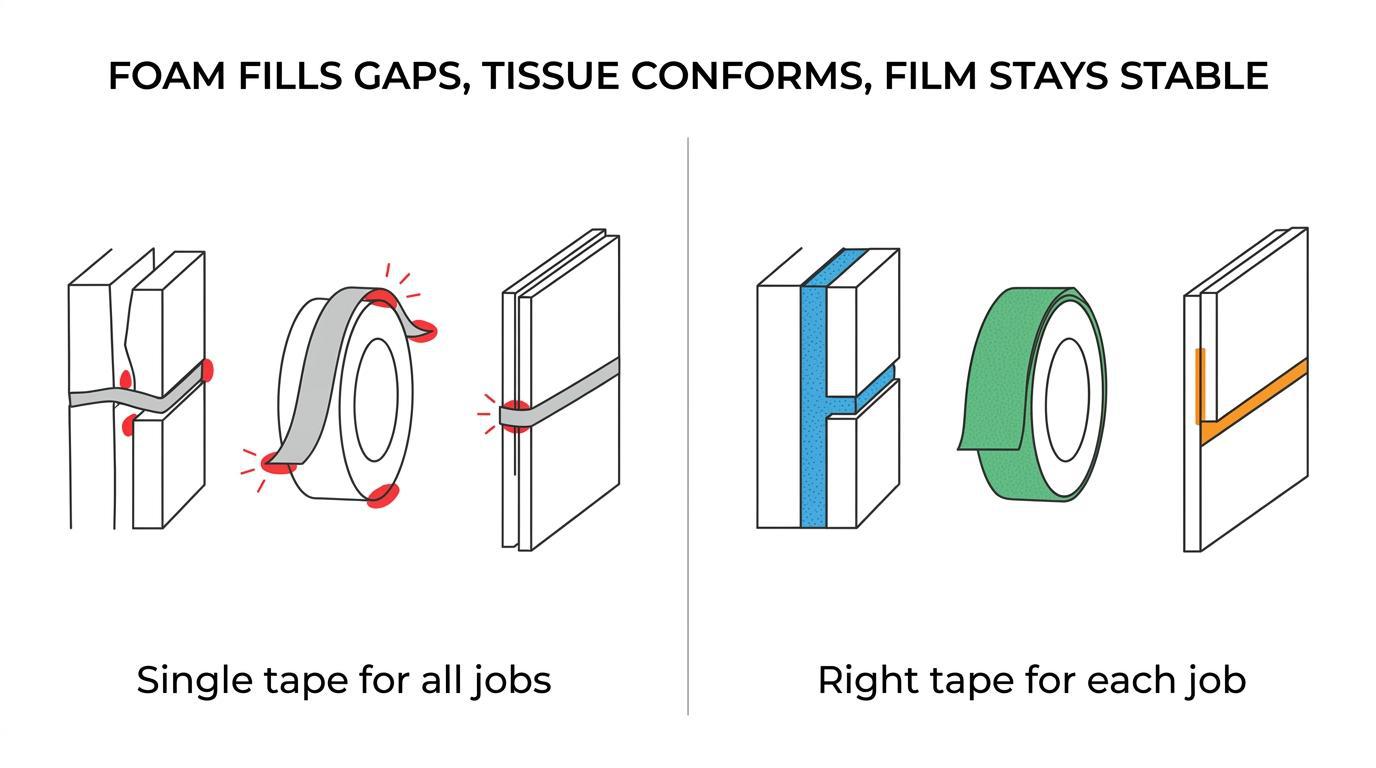
Foam tapes compress and recover, which helps on uneven surfaces and under vibration. That makes them a strong choice for mounting, trim attachment, and interfaces where parts are not perfectly flat. The trade-off is that thicker foam can change stack-up and may not suit very thin bond lines.
Tissue carriers are flexible and forgiving. They work well for laminating foams, felts, and lightweight components. They also convert well into custom shapes. Their limitation is structural rigidity. If precise die-cut handling or narrow tolerance placement matters, tissue may feel less controlled than film.
Film carriers, especially polyester-film constructions, stay flatter and more stable during converting and placement. They are useful where clean edges and repeatable thickness matter. The downside is lower conformability on rough textures compared with foam or tissue.
Mounting tape vs transfer tape vs double-coated tape: what is the real difference?
Mounting tape is usually thicker and more structural, transfer tape is the thinnest option with no carrier, and double-coated tape sits in the middle with adhesive on both sides of a carrier.
This terminology confuses many buyers because products can overlap in use. The easiest way to separate them is by construction:
-
Mounting tape: thicker bond line, better gap filling, often foam-based
-
Transfer tape: pure adhesive on a release liner, ideal for smooth substrates and minimal thickness
-
Double-coated tape: carrier-backed construction that balances handling, converting, and bond performance
If you need easy handling, die-cut stability, or a controlled internal layer, double-coated tape is often the safer choice. If every mil counts and the surfaces are smooth, transfer tape may be better. If the surfaces are uneven or the assembly sees vibration, mounting tape usually has the edge.
How should you apply double sided tape to get full wet out and bond strength?
Clean the surface, apply pressure, and allow dwell time. Even high-grade acrylic tape underperforms if contamination or weak application pressure blocks wet out.
Start with surface prep. Dust, oil, mold release, oxidation, and fingerprints can reduce real contact area. On critical jobs, even a visually clean surface may need a solvent wipe or a defined prep procedure based on the substrate.
Then apply enough pressure to build contact across the bond line. Pressure-sensitive adhesive needs intimate contact with the surface. That is what “wet out” means in practice. If the tape is only touching peaks on a textured part, you are not getting the full design performance.
Finally, give the bond time. Many tapes build strength after application as the adhesive flows and contact improves. Pro tip: do not judge final bond quality by the first 30 seconds unless the application truly depends on instant grab.
When should temperature ratings and elevated-temperature shear change your choice?
Temperature ratings should change your choice any time the bond sees ovens, hot enclosures, sun load, or warm electronics. ASTM D3654 elevated-temperature shear concepts matter because heat often exposes creep before peel failure appears.
A practical example helps. One tissue-carrier double-coated tape is listed at 300°F short term and 260°F for days or weeks. Another 8 mil double-coated tape is listed at 300°F short term and 200°F long term. Those are not small differences. They change which product fits a brief heat spike versus sustained exposure.
If the part sees only room temperature assembly, many tapes can work. If it must hold under heat while carrying load, narrow your choices quickly. Common mistake: treating “short-term max temperature” as if it were the normal operating rating.
“Slip Stream 24/7 notes 3M GPT-020TF is an 8 mil double-coated tape suitable for both high- and low-surface-energy materials, with short-term use up to 300°F/149°C and long-term use up to 200°F/93°C.”
When do you need lab testing or a production trial before committing?
You need testing when the substrates are hard to bond, the load is meaningful, or failure would be expensive. Real-part trials beat generic assumptions, especially on plastics, textured coatings, and heated assemblies.
ASTM methods are useful because they separate failure modes. Use peel-style checks when edge lift or pullback is the concern. Use shear-style checks when the bond must carry load over time. ASTM D3654 is especially relevant when heat and sustained stress are both in play.
A small production trial is often enough to reveal issues that a bench sample misses. If the bond line changes with operator pressure, if a liner is difficult to remove, or if one lot of painted parts performs differently, those are process signals, not just product signals. If the application is critical, test the real substrates, with real prep, at real temperatures, and in the real load direction.