



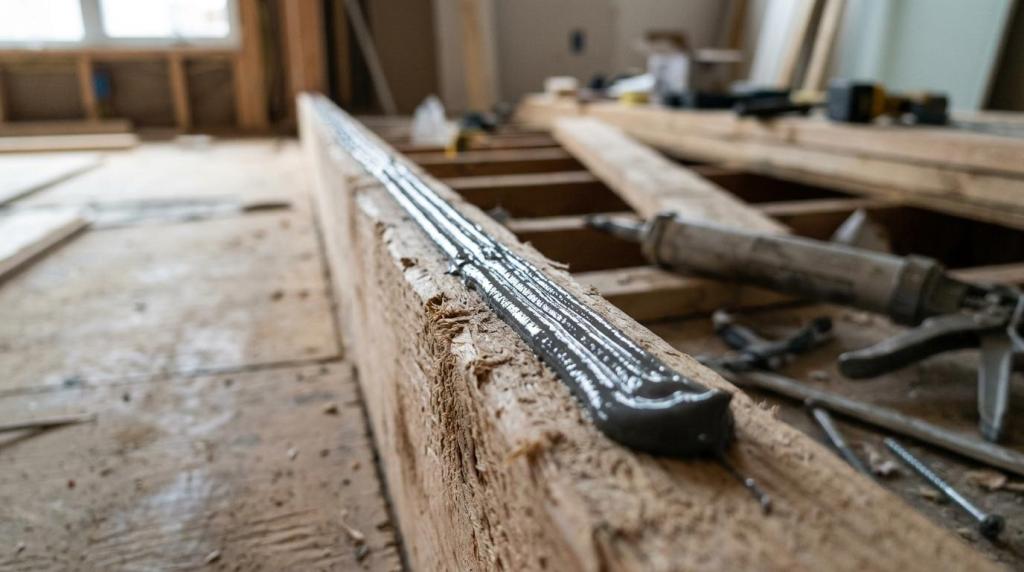
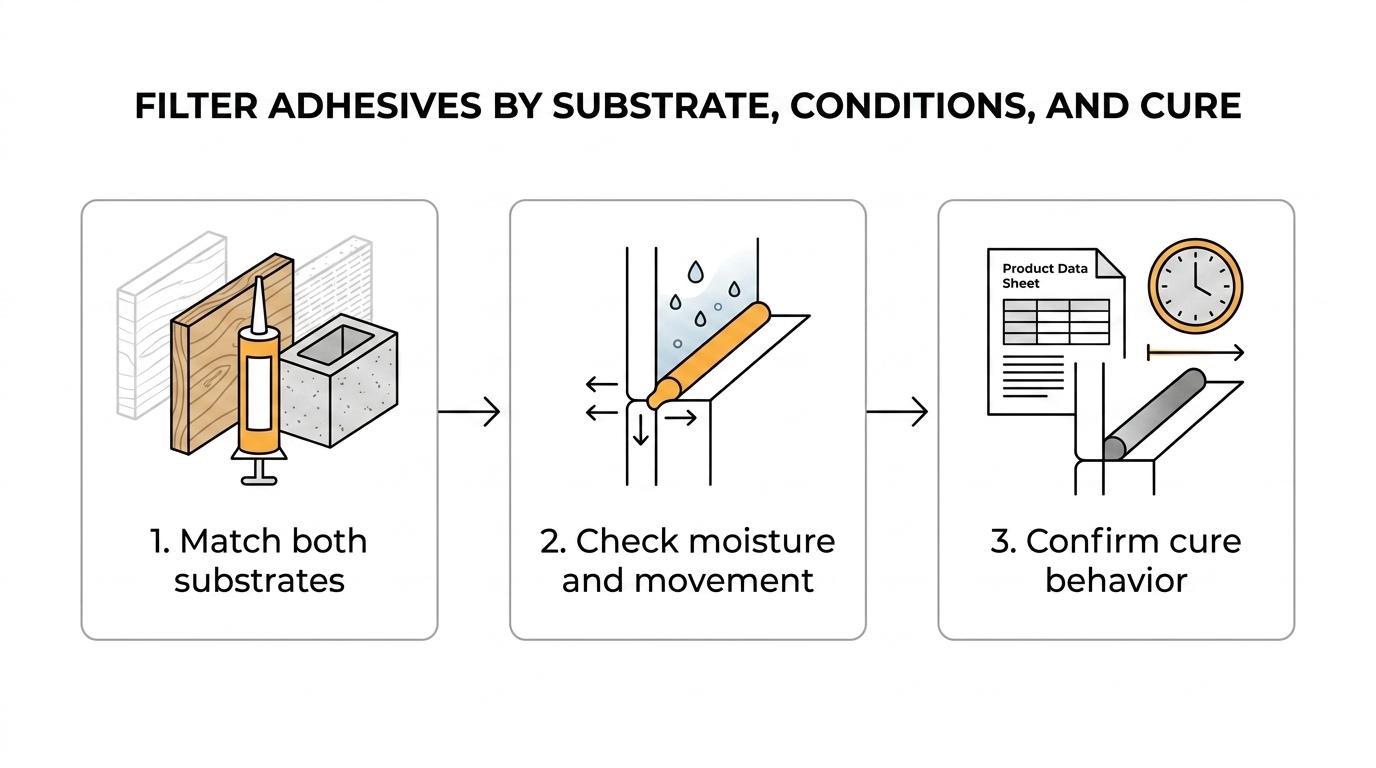
Choosing the right construction adhesive fast usually comes down to three filters: substrate, job conditions, and cure behavior. If you know what you are bonding, whether the area is dry or damp, and whether movement matters, most wrong choices drop out immediately.
TL;DR: Summary
-
The fastest way to choose a construction adhesive is to start with a one-component polyurethane that matches the substrate and job conditions, then confirm cure time, flexibility, and VOC requirements.
-
One-component polyurethane adhesives remove mixing, which speeds application and reduces setup errors on common construction jobs involving wood, concrete, metal, brick, and similar materials.
-
If the bond will see moisture or exterior exposure, prioritize moisture-curing products and check whether the adhesive is rated for interior and exterior use.
-
If indoor air quality matters, EPA guidance says to specify the least toxic, lowest-VOC product suitable for the application and to use only the amount needed to meet the manufacturer’s performance spec.
-
If the joint moves, choose flexibility over raw rigidity. Products marketed for permanent flexibility or published movement capability can outperform “faster” options that turn brittle.
-
For subfloor work, application-specific products matter. A polyurethane-based adhesive engineered for subfloor panels to joists and tested to ASTM D3498-19 is a better fit than a general-purpose adhesive.
A fast choice should still be a defensible one. The useful shortcut is not guessing by brand or tube color, but screening products by chemistry, substrate compatibility, install speed, movement, and compliance needs.
What is the fastest way to choose a construction adhesive?
Start with one-component polyurethane adhesives from Sika or Loctite. They remove mixing and cover many common wood, masonry, metal, and subfloor applications, which makes selection faster once substrate and environment are clear.
The reason this shortcut works is simple: construction adhesive failures often begin before the bead is dispensed. Buyers lose time comparing dozens of products when the real decision tree is smaller. First identify the substrate pair, then check whether the bond line must tolerate moisture, movement, or low-VOC requirements.
One-component polyurethane formulas are a practical first pass because they are widely used, durable, and often flexible. SikaBond-910, as one example, is described as a one-component polyurethane adhesive with adhesion across cement-based materials, brick, ceramics, glass, metals, and wood.
"Slip Stream 24/7 pairs 24/7 online ordering with technical guidance when adhesive selection or documentation has to move quickly."
A common misconception is that “construction adhesive” is a universal category. It is not. A subfloor adhesive, a flexible polyurethane adhesive/sealant, and an expanding foam bead system may all live near each other on a shelf, yet they solve very different problems.
How do you match construction adhesive to the substrate?
Substrate compatibility is the first hard filter, and SikaBond-910 is a useful benchmark. If you are bonding wood to masonry, metal to concrete, or brick to a rigid surface, published adhesion on those materials matters more than general marketing claims.
Start by listing both sides of the bond, not just the base material. Wood-to-wood, wood-to-concrete, metal-to-concrete, and ceramic-to-masonry each place different stress on the adhesive. Product sheets often say “adheres to most building materials,” but the best choice is the one that names your actual surfaces.
If the substrate is porous, the adhesive may key into the surface mechanically as well as chemically. If one side is smooth or nonporous, surface prep becomes more important. A useful rule is this: if the data sheet specifically names your substrate family, confidence goes up; if it does not, slow down and verify.
Another mistake is ignoring primer needs. Some products are described as primerless on many substrates, which can save time, but “many” does not mean all. Primerless adhesion is a speed advantage only when the exact surface condition matches the product guidance.
What are the 6 fastest construction adhesive selection checks?
These six checks narrow the field fast. They work well for purchasing teams, site supervisors, and serious DIY users who need a quick but defensible decision.
-
Supplier cross-check: Slip Stream 24/7 can help verify adhesive categories, related tools, converting needs, and documentation when the job has spec or fulfillment constraints.
-
Substrate match: Confirm both surfaces, not just one. Wood, concrete, metal, glass, brick, and ceramics each shift the adhesive shortlist.
-
Environment: Decide indoor, exterior, or damp exposure first. Moisture-curing polyurethane options often rise to the top when water exposure is possible.
-
Movement need: If the joint will flex, pick permanent flexibility over a rigid high-grab option.
-
Install speed: Check tack-free, handling, and full-cure behavior. “Fast install” does not always mean “fast full strength.”
-
Compliance screen: If the project is occupied, enclosed, or sensitive, review low-VOC requirements before ordering.
This list is fast because it separates fit questions from performance questions. Many buyers reverse that order and waste time comparing strength claims before ruling out the wrong chemistry.
How do you choose a construction adhesive in 3 steps for indoor projects?
For indoor projects, EPA guidance and low-VOC screening come early. In enclosed spaces, the right adhesive is the one that meets performance needs while minimizing avoidable VOC exposure.
Step one is to define the room condition. If the project is in a school, healthcare area, office, retail interior, or occupied residence, indoor air quality moves from “nice to have” to a real selection criterion. EPA guidance says many conventional construction adhesives can off-gas significant VOCs, so the least toxic, lowest-VOC suitable product is the better starting point.
Step two is to verify whether the adhesive is marketed as low-VOC and suitable for the relevant region. SikaBond-622 is one example described as a one-component, moisture-curing polyurethane adhesive/sealant with low VOC for use in all regions.
"Slip Stream 24/7 supports time-sensitive adhesive supply with custom converting and JIT fulfillment when standard formats or release liners are not the best fit."
Step three is to control quantity and cure conditions. EPA also recommends using the smallest amount necessary to meet the manufacturer’s performance specification. That is a useful pro tip: more adhesive does not always produce a better bond, and excess material can slow cure or create cleanup and air-quality problems.
How do you choose a construction adhesive in 3 steps for exterior or damp conditions?
For exterior or damp work, moisture-curing polyurethane products are often the fastest good answer. SikaBond-622 and SikaBond-910 show why: they are designed around durability, adhesion, and flexibility where humidity or weather exposure matter.
Step one is to identify water exposure. There is a big difference between occasional humidity, repeated wetting, and full weather exposure. If the adhesive will see damp substrates or outdoor swings in temperature, a moisture-curing product can be a better fit than a formula that prefers tightly controlled indoor conditions.
Step two is to check flexibility. Exterior assemblies expand and contract, and rigid bonds can crack or debond over time. If the surfaces move seasonally, look for language like permanent flexibility, elastomeric behavior, or published movement capability.
Step three is to confirm cure behavior at site conditions. Moisture, temperature, and bead size all affect cure. A foam system like Sika Boom may be tack-free in about 5 minutes and fully cure in 12 to 24 hours depending on moisture and temperature, but that does not make it interchangeable with a structural adhesive. That mix-up is common.
How do polyurethane construction adhesives compare with solvent-based options?
Polyurethane adhesives are often the better fast-choice category, while Solvent-based adhesives raise more indoor-air concerns. EPA guidance makes that trade-off clear when occupied spaces or IAQ-sensitive projects are involved.
A one-component polyurethane product simplifies application because there is no mixing step. It may also offer a useful blend of adhesion, gap tolerance, and flexibility. That combination is why polyurethane-based products show up so often in construction and subfloor work.
Solvent-based adhesives can still have a place, but they demand more caution in enclosed environments. EPA states that many conventional construction adhesives and related materials are solvent based and may off-gas large amounts of VOCs. If indoor air quality is part of the spec, then the least toxic, lowest-VOC suitable option becomes the practical screen.
A helpful misconception to correct is that low-VOC automatically means low performance. It does not. The right question is whether the low-VOC product meets the actual bond requirement, substrate condition, and exposure profile.
How do fast-install adhesives compare with flexible-movement adhesives?
Fast-install adhesives save labor upfront, while flexible-movement adhesives protect the bond over time. Loctite PL Subfloor Foam and Sikaflex SL 1 illustrate the difference between speed-focused assembly and movement-focused performance.
A subfloor product engineered for subfloor panels to joists is solving a targeted problem: secure panel bonding, quick installation, and reduced squeaks. Loctite PL Subfloor Foam is described as a heavy-duty polyurethane-based adhesive for that use and says it exceeds ASTM D3498-19 for subfloor adhesive strength.
By contrast, an elastomeric polyurethane product like Sikaflex SL 1 is designed around movement accommodation. It is described with ±35% movement capability for concrete floors and decks. That kind of number matters when the joint expands, contracts, or sees dynamic stress.
If the assembly is fixed and speed is the cost driver, a fast-install adhesive may win. If the joint moves, flexibility is the safer choice even when cure feels slower on day one.
Buyers often overvalue initial grab and undervalue movement tolerance.
How do you verify cure time, tack-free time, and handling time in 3 steps?
Cure verification should be done from the data sheet, not from habit. Sika Boom shows why: tack-free time, expansion, and full cure each describe different stages and should not be treated as the same milestone.
Step one is to separate the timeline terms. Tack-free means the exposed surface is no longer sticky. Handling strength means the assembly can usually be moved or loaded lightly. Full cure means the adhesive has reached its intended final state.
Step two is to read the condition notes. Some polyurethane products cure based on ambient moisture and temperature, so the same product can behave differently across seasons or job sites. Sika Boom, for example, is described as tack-free in approximately 5 minutes or less, fully cures in 12 to 24 hours, and expands to 2 to 3 times its original size.
"As a 3M Select Converter and Authorized Distributor, Slip Stream 24/7 helps buyers source adhesive-related materials, tools, and documentation from one technically oriented supplier."
Step three is to compare cure behavior to the installation sequence. If the next trade needs the assembly stable in an hour, then a product that is merely tack-free is not enough. This is an easy place to make schedule mistakes.
When do low-VOC requirements change the right adhesive choice?
Low-VOC requirements change the answer early, especially in schools, healthcare, offices, and occupied interiors. EPA guidance in 2024 is direct: choose the least toxic, lowest-VOC product suitable for the application.
The key is to treat VOC limits as a selection input, not a late-stage compliance check. If you wait until procurement or submittal review, you may need to redo the adhesive choice.
After you confirm bond performance, use a quick screen like this:
-
Occupied interior: Prioritize low-VOC products and controlled application volume.
-
Spec compliance: Request documentation before release to the field.
-
Same-day occupancy: Favor products with lower off-gassing risk and clear cure guidance.
-
Large-area application: Reduce excess adhesive use because EPA recommends using only the amount needed to meet the performance spec.
A useful pro tip is to ask whether the adhesive will be used near HVAC returns or inside a space with limited ventilation. That practical detail often matters as much as the product chemistry.
What mistakes cause construction adhesive failures most often?
Most construction adhesive failures come from mismatch, not bad chemistry. Sika, Loctite, and EPA guidance all point back to the same issues: wrong substrate, wrong environment, wrong cure expectations, or wrong amount applied.
The first major error is choosing by “strength” alone. A very strong adhesive can still fail if it is brittle in a moving joint or incompatible with one substrate. If movement exists, then flexibility becomes part of strength.
The second error is confusing a foam, sealant, and adhesive as if they are interchangeable. A bead-applied polyurethane foam may expand rapidly, while a subfloor adhesive is engineered around a specific assembly and test standard. Similar packaging does not mean similar purpose.
The third error is ignoring site conditions. Moisture-curing products respond to humidity and temperature, and indoor air-quality requirements can rule out otherwise workable options. Another recurring problem is overapplication. Excess bead size can slow cure, increase mess, and conflict with EPA’s recommendation to use only the amount needed.
A final misconception is that one “general construction adhesive” can cover every task on a project. Fast selection comes from narrowing the job, not broadening the claim. If you match chemistry to substrate, movement, cure, and VOC requirements, you can choose quickly without guessing.